
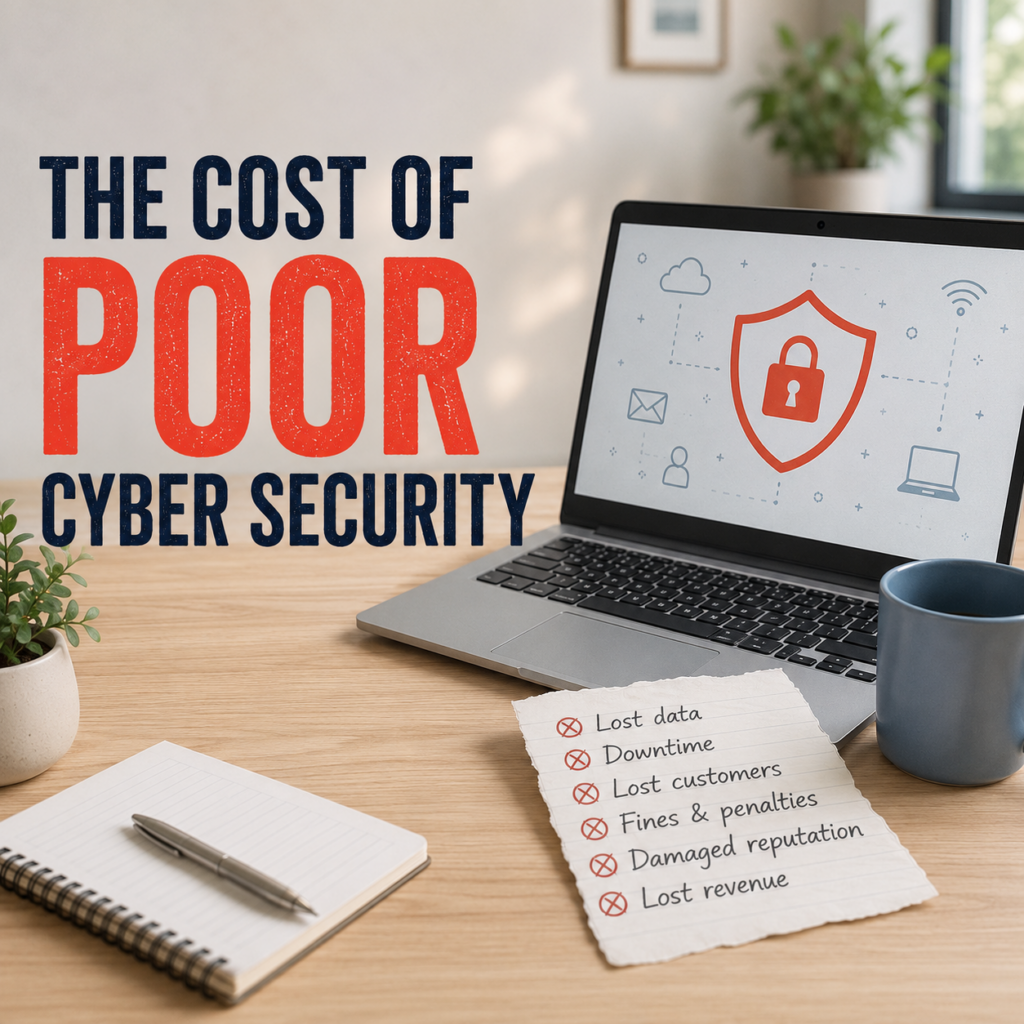
When most businesses think about cyber security, they tend to picture headlines about ransomware demands, stolen bank details or eye-watering regulatory fines. Those stories certainly grab attention, but they only tell part of the story. In reality, the biggest cost of poor cyber security is often the damage that doesn’t appear on a balance sheet.
A cyber attack can shake customer confidence, disrupt day-to-day operations, affect staff morale and tarnish a reputation that has taken years to build. While money can often be recovered over time, trust is far harder to replace. Once people begin to question whether their information is safe in your hands, rebuilding that confidence becomes a long-term challenge rather than a quick fix.
Let’s be honest, cyber security isn’t always the most exciting item on a business owner’s to-do list. There are clients to look after, projects to deliver, invoices to chase and a hundred other priorities competing for attention. It is easy to assume that cyber criminals are interested only in multinational organisations with huge budgets and vast amounts of sensitive data. Unfortunately, that’s exactly the misconception that leaves many smaller businesses vulnerable.
Cyber criminals aren’t necessarily looking for the biggest target; they’re looking for the easiest one. Much of today’s cybercrime is automated, with software constantly scanning websites, networks and email systems for weaknesses. Think of it as someone walking down a street quietly trying every front door. They aren’t concerned whose house it is; they’re simply waiting to find one that has been left unlocked. Businesses are no different. An outdated piece of software, a weak password or one convincing phishing email can be all it takes to open the door.
Every organisation has something worth protecting. It might be customer records, employee information, financial data, confidential contracts or simply access to company email accounts. Even businesses that believe they hold very little sensitive information often underestimate the value of what they have. Criminals don’t always want your data for themselves. Sometimes they want access to your systems so they can impersonate your business, launch attacks on others or demand payment to restore your files.
The Financial Cost Is Only the Beginning
When a cyber incident occurs, the immediate costs are usually the easiest to identify. Businesses may need to bring in IT specialists to investigate what happened, recover systems, restore data from backups and ensure attackers no longer have access to the network. Depending on the severity of the incident, there may also be legal fees, regulatory reporting requirements, customer notifications and increased insurance premiums to consider.
Those costs can mount up remarkably quickly, but they are only part of the picture. What often catches businesses by surprise are the hidden costs that continue long after the technical issues have been resolved.
Imagine your systems are offline for three days. Your team can’t access customer records, invoices can’t be raised, orders can’t be processed and emails are unavailable. The phones continue ringing because your customers still need support, but your staff are forced to work around systems they rely on every day. Deadlines slip, projects are delayed and opportunities are missed. Even when everything is eventually restored, the backlog doesn’t magically disappear. It can take weeks, sometimes months, to recover fully.
Lost productivity is one of the most expensive consequences of poor cyber security because it affects every part of the organisation. Unlike replacing a laptop or paying an invoice, lost time can never be recovered.
Trust Is Built Over Years and Lost in Moments
Trust is one of the few business assets that cannot be bought. It is earned through consistently delivering excellent service, acting professionally and demonstrating that customers can rely on you.
Every time someone shares their personal information with your business, they are placing a degree of trust in your organisation. They expect you to protect their contact details, payment information and confidential conversations with the same care that you would protect your own.
When a cyber attack results in sensitive information being exposed, customers naturally begin asking questions. Could this have been prevented? Has my information been misused? Is this organisation taking security seriously enough?
Most people understand that cyber crime is an unfortunate reality of modern business, but they also expect organisations to take sensible precautions. If customers believe a breach occurred because basic security measures were ignored, confidence can disappear remarkably quickly.
Rebuilding that trust takes far longer than losing it. It requires openness, transparency and clear evidence that lessons have been learned. Even then, some customers may choose to take their business elsewhere because peace of mind is difficult to put a price on.
Your Reputation Is One of Your Greatest Assets
Every positive customer review, recommendation and successful project contributes to your reputation. It’s something businesses spend years nurturing through hard work, investment and consistently delivering on promises.
Unfortunately, cyber incidents have a habit of becoming part of that reputation too.
News spreads incredibly quickly. Whether through social media, local news websites or word of mouth, stories about cyber attacks travel fast. Even months later, prospective customers researching your business may discover reports of the incident before they ever visit your website.
The good news is that customers often judge businesses as much on their response as the incident itself. Organisations that communicate openly, act quickly and demonstrate they have strengthened their security afterwards are more likely to retain confidence than those who remain silent or appear unprepared.
In many ways, how you respond to a cyber incident says as much about your business as the incident itself.
The Human Cost Is Often Overlooked
It’s easy to focus on systems and technology, but cyber security is ultimately about people.
Behind every phishing email that is opened or fraudulent payment that is authorised is usually someone who was simply trying to do their job. Today’s cyber criminals are highly skilled at creating convincing scams. Emails appear to come from trusted colleagues, suppliers or banks. Websites can look almost identical to legitimate ones. Artificial intelligence is making these attacks even more convincing.
When an employee unknowingly makes a mistake, they often feel embarrassed or anxious. Some worry they will be blamed or disciplined, even when the attack could have fooled almost anyone.
The most resilient organisations understand that cyber security is not about catching people out. It’s about creating a culture where employees feel confident asking questions, reporting suspicious activity and learning from mistakes without fear.
Well-trained employees are not your weakest link. They are one of your strongest defences.
Cyber Security Is No Longer Just an IT Issue
There was a time when cyber security was considered the responsibility of the IT department. That simply isn’t true anymore.
Finance teams authorise payments that criminals may attempt to redirect. Human Resources departments manage highly sensitive employee records. Marketing teams oversee websites, social media accounts and customer databases. Directors make decisions about investment, suppliers and risk management.
In reality, every department plays a role in protecting the organisation.
Cyber security is much like health and safety. While specialists provide guidance and expertise, everyone has a responsibility to follow good practice. The same principle applies to protecting digital assets. Strong technology is important, but it becomes far more effective when combined with informed, engaged employees who understand the role they play in keeping the business secure.
Prevention Is Almost Always Less Expensive Than Recovery
One of the most reassuring things about cybersecurity is that some of the most effective protections are also among the simplest. Businesses sometimes assume they need to invest in expensive software or complex technology before they can improve their security, but that’s rarely the case. More often than not, resilience is built through a series of sensible, practical measures that work together to reduce risk.
Keeping software up to date is a good example. Software developers regularly release updates to fix security vulnerabilities that criminals have already identified. Delaying those updates can leave the door open for attackers who are actively looking for businesses running outdated systems. It’s a little like ignoring a broken lock on your office door because it’s still just about working. Eventually, someone will notice.
Strong passwords remain another fundamental defence, yet they continue to be overlooked. Using unique passwords for different accounts, combined with multi-factor authentication, makes it significantly more difficult for criminals to gain unauthorised access. Even if a password is compromised, that additional layer of security can stop an attacker in their tracks.
Regular backups are equally important. No organisation wants to imagine losing access to its systems, but having secure, tested backups can mean the difference between a temporary inconvenience and a business-threatening crisis. A backup isn’t much use if you discover, during an emergency, that it hasn’t been working properly for the past six months. Testing your recovery process is just as important as creating the backup itself.
Perhaps the most valuable investment of all is educating your people. Technology can identify many threats, but employees are often the first line of defence. Helping staff recognise phishing emails, suspicious links and unusual requests creates an extra layer of protection that no software can fully replace.
Cyber Security Can Become a Competitive Advantage
Many business owners still see cyber security as an unavoidable expense or simply another compliance requirement. Increasingly, however, it is becoming something that helps organisations stand out for the right reasons.
Customers are more aware than ever of how their information is collected, stored and protected. Before choosing a supplier, many organisations now ask questions about cyber security, data protection and business resilience. This is particularly common when working with larger companies, public sector organisations and businesses operating within regulated industries.
Demonstrating that your organisation takes cyber security seriously can provide reassurance to prospective customers and strengthen existing relationships. It shows that you value the trust people place in your business and that protecting their information is part of your commitment to delivering a professional service.
In many cases, good cyber security is no longer just about reducing risk. It has become part of building a trusted, credible brand.
Preparing for the Future, Not Just Today’s Threats
Cybercrime continues to evolve at an astonishing pace. Criminals are constantly finding new ways to exploit technology and human behaviour, while artificial intelligence is enabling scams that are becoming increasingly difficult to detect. Fraudsters can now generate highly convincing emails, imitate writing styles and even clone voices to make fraudulent phone calls appear genuine.
The cyber threats businesses face next year are unlikely to look exactly like those they face today. That’s why cyber security should never be viewed as a one-off project or something to revisit only after an incident has occurred.
The most resilient organisations treat cyber security as an ongoing process of continuous improvement. They regularly review their systems, update their policies, provide refresher training for employees and stay informed about emerging risks. Rather than asking, “Are we secure?” they ask, “How can we become more resilient?”
That subtle shift in thinking makes a significant difference. It’s impossible to eliminate every risk, but it is entirely possible to build a business that is prepared to respond quickly, minimise disruption and recover effectively if the unexpected happens.
Good Cyber Security Is Good Business
When you strip away the technical language, cyber security is really about protecting the things that matter most to your organisation. It’s about safeguarding your customers, supporting your employees, protecting your reputation and ensuring your business can continue operating when challenges arise.
Every organisation invests time and effort into building relationships. Winning new customers takes dedication, retaining them requires trust and growing a business depends on confidence. Cyber security underpins all of those things.
It’s often said that reputation takes years to build and moments to lose, and nowhere is that more relevant than in the digital world. A single cyber incident may not define your business, but how prepared you were beforehand and how you respond afterwards will certainly influence how customers remember you.
Rather than seeing cyber security as another box to tick, it’s worth viewing it as an investment in your organisation’s future. Businesses that take a proactive approach are not only better protected against cyber threats, but they are also better positioned to build lasting relationships, win new opportunities and demonstrate that they take their responsibilities seriously.
After all, protecting your business isn’t simply about keeping criminals out. It’s about giving your customers every reason to keep choosing you.
How Green Arrow Consultancy Can Help
At Green Arrow Consultancy, we understand that cyber security can feel overwhelming, particularly when you’re busy running a business. Technology moves quickly, cyber threats continue to evolve, and it isn’t always obvious where to focus your efforts. That’s where we come in.
Our approach is built around making cyber security practical, understandable and proportionate to your organisation. We believe effective cyber security isn’t about creating fear or burying businesses in technical jargon. It’s about identifying the areas that present the greatest risk, putting sensible measures in place and helping you build confidence that your business is protected.
Whether you need support reviewing your existing cyber security arrangements, developing policies and procedures, improving staff awareness, strengthening compliance or understanding where your vulnerabilities lie, our experienced team can provide clear, straightforward guidance tailored to your organisation.
We work alongside businesses to help them reduce risk, improve resilience and create a culture where cyber security becomes part of everyday operations rather than an afterthought. By taking a proactive approach, you’ll not only strengthen your defences against cyber threats but also demonstrate to customers, suppliers and partners that protecting their information is a priority.
The cost of poor cyber security extends far beyond financial loss. It can affect your reputation, your relationships and the confidence people place in your business. Taking action today is almost always easier, and considerably less expensive, than dealing with the consequences tomorrow.
If you’d like to better understand your cyber security risks or explore practical ways to strengthen your organisation’s resilience, Green Arrow Consultancy is here to help. Together, we can ensure your business is not only prepared for today’s challenges but ready for whatever the future brings.